
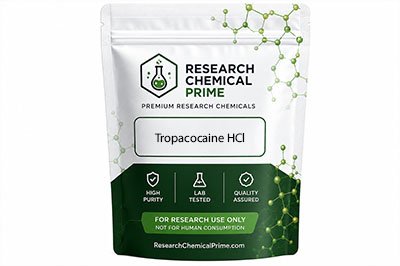
Tropacocaine Hydrochloride
Tropacocaine is a naturally occurring tropane alkaloid that has been reported in several plant species. It is structurally distinct from cocaine while sharing the broader tropane-alkaloid framework. PubChem classifies tropacocaine among cocaine alkaloids in its chemical records.
The hydrochloride form represents the salt form of tropacocaine and is recorded in chemical databases as tropacocaine hydrochloride.
This reference entry is intended solely to summarize chemical and scientific information. It does not constitute medical, therapeutic, or experimental-use guidance.
3. Structural and Chemical Characteristics
Tropacocaine contains a tropane-based bicyclic nitrogen-containing framework with a benzoate ester functionality. The hydrochloride form additionally contains hydrochloride associated with the basic nitrogen.
Relevant database identifiers include:
| Property | Reference information |
|---|---|
| Compound | Tropacocaine hydrochloride |
| CAS RN | 637-23-0 |
| Parent tropacocaine CAS RN | 537-26-8 |
| Formula | C₁₅H₂₀ClNO₂ |
| Molecular weight | 281.78 g/mol |
| Chemical class | Tropane alkaloid / ester |
| Appearance | Reported as crystalline material; physical appearance should be confirmed for the individual material |
PubChem provides structural identifiers including an InChI, InChIKey, and canonical SMILES for the hydrochloride form.
4. Scientific and Pharmacological Context
Historical and pharmacological literature has investigated tropacocaine in connection with tropane alkaloid chemistry, local-anesthetic pharmacology, and interactions with neuronal transport systems.
Because pharmacological activity can depend on experimental conditions, stereochemistry, concentration, assay system, and material identity, individual findings should not be generalized into predictions about effects in humans.
Claims that tropacocaine has a particular duration, reduced dependence potential, reduced toxicity, or a defined advantage over cocaine should not be treated as established safety conclusions without appropriate comparative evidence.
5. Potential Research Areas
Tropacocaine may occur in scientific literature concerning:
- Tropane alkaloid structure–activity relationships
- Neurotransmitter transporter research
- Comparative studies of structurally related alkaloids
- Mechanistic research involving local-anesthetic pharmacology
- Analytical identification of tropane compounds
- Forensic and toxicological chemistry
- Mass-spectrometric and chromatographic characterization
- Natural-products chemistry
- Chemical structure and stereochemistry investigations
These areas describe scientific subjects rather than recommended experimental procedures.
6. Analytical Characterization
Tropacocaine has documented analytical records in chemical databases, including mass-spectrometric and spectroscopic information. PubChem references GC-MS data and NMR records associated with tropacocaine.
For any specific material, identity and composition should be established using appropriate validated analytical methods and batch-specific documentation.
Reported supplier specifications such as:
- HPLC purity
- Heavy-metal limits
- Residual-solvent limits
- Loss-on-drying values
- Microbiological specifications
- Stability or shelf-life periods
should not be presented as verified characteristics unless supported by appropriate documentation for the particular batch.
7. Safety and Hazard Considerations
Tropacocaine hydrochloride should be treated as a substance requiring appropriate laboratory chemical controls.
PubChem’s Laboratory Chemical Safety Summary reports hazard classifications associated with tropacocaine hydrochloride, including acute toxicity classifications and other hazard statements.
Accordingly:
- Avoid unnecessary exposure.
- Prevent contact with skin and eyes.
- Avoid inhalation of dust or aerosols.
- Use appropriate laboratory PPE and engineering controls.
- Consult the applicable Safety Data Sheet before handling.
- Keep the material appropriately labeled and secured.
- Dispose of material according to applicable institutional and regulatory procedures.
No assumption should be made that a compound is safe merely because it is being investigated in a laboratory.
8. Human and Animal Use
Tropacocaine hydrochloride should not be interpreted from this reference as suitable for human consumption, self-experimentation, medical treatment, or unsupervised administration.
This entry does not provide human or animal dosing information, routes of administration, preparation instructions, or protocols for producing pharmacological effects.
Animal research, where scientifically justified, should be conducted only under applicable institutional oversight and approved ethical procedures.
9. Regulatory Considerations
The legal and regulatory status of tropacocaine can differ between jurisdictions and may change over time.
PubChem identifies tropacocaine within a cocaine-alkaloid classification and provides regulatory-source information including DEA-related records.
Consequently, regulatory status should be determined using the current official legislation and competent authorities in the relevant jurisdiction, rather than relying solely on commercial descriptions or historical claims.
10. Storage and Laboratory Management
Storage conditions should be established from the applicable Safety Data Sheet, supplier documentation, and validated stability information for the specific material.
General laboratory management principles include:
- Keep the material in appropriately labeled, closed packaging.
- Protect it from conditions identified as potentially degrading.
- Maintain appropriate environmental controls.
- Keep chemical records and batch identification documentation.
- Segregate and dispose of material according to institutional procedures.
An unsupported “36-month shelf life” should not be treated as a confirmed stability specification.
11. Documentation
For scientifically documented material, relevant records may include:
- Certificate of Analysis, where legitimately provided
- Safety Data Sheet
- Batch or lot number
- Analytical identification data
- Chromatographic or spectrometric records
- Supplier specification sheet
- Storage information
- Applicable regulatory documentation
Documentation should be evaluated for authenticity, applicability to the specific batch, and analytical methodology.
12. Key Scientific Notes
- Tropacocaine is not cocaine. They are structurally distinct tropane alkaloids.
- Tropacocaine and tropacocaine hydrochloride should be distinguished. Their database identifiers are different.
- CAS 537-26-8 refers to tropacocaine, whereas PubChem lists 637-23-0 for tropacocaine hydrochloride.
- The molecular formula of the hydrochloride is C₁₅H₂₀ClNO₂, with molecular weight 281.78 g/mol.
- “Benzoylecgonine methyl ester” should not be used as a synonym for tropacocaine.
- Claims concerning relative potency, dependence potential, toxicity, duration, or therapeutic usefulness require appropriate comparative evidence.
13. Research-Only Disclaimer
This document is provided for general scientific and chemical-reference purposes only. It is not medical advice and does not recommend human or animal use. It does not provide instructions for preparation, administration, dosing, or achieving pharmacological effects. Any legitimate laboratory investigation must comply with applicable institutional safety procedures, ethical requirements, and local laws.
Reviews
There are no reviews yet.