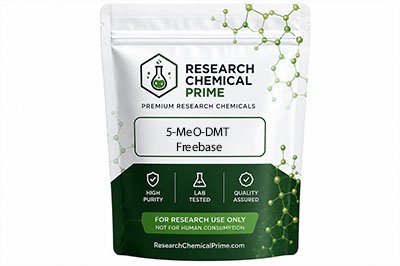
5-MeO-DMT Freebase | Tryptamine Analytical Reference Standard
5-MeO-DMT Freebase (5-Methoxy-N,N-dimethyltryptamine) is a specialized semi-synthetic substituted tryptamine derivative. Characterized by its distinct 5-methoxy and N,N-dimethyl substitution pattern, it serves as a critical reference standard for advanced scientific investigation into serotonergic signaling pathways, rapid receptor kinetics, and structure-activity relationships (SARs) within the broader tryptamine class.
Supplied in its freebase form, this compound offers superior volatility, making it uniquely valuable for specific analytical techniques such as gas chromatography (GC) and specialized evaporation-based deposition methods. It is rigorously synthesized to ensure exceptional chemical purity and reproducible results for quantitative in vitro workflows.
Key Features & Quality Assurance
- Exceptional Analytical Purity (≥98%): Rigorously verified via HPLC-UV and GC-MS to ensure reliable baseline data and minimal synthetic impurities.
- Optimized Volatility: The freebase form is specifically engineered for applications requiring precise thermal volatility, such as GC-MS calibration and specialized analytical deposition.
- Comprehensive Analytical Certification: Every batch is accompanied by an extensive analytical dossier, including HPLC-UV chromatograms, GC-MS confirmation, residual solvent analysis, and Karl Fischer water content determination.
- Precision Formulation: Manufactured under strict quality control protocols to guarantee exact compositional reliability for controlled in vitro assay calibration.
Primary Research Applications
- Receptor Binding Assays: In vitro evaluation of ligand affinity and agonist profiles at specific serotonergic receptor subtypes, particularly 5-HT1A and 5-HT2A.
- In Vitro Metabolic Profiling: Investigation of enzymatic degradation pathways, including CYP450 (e.g., CYP2D6) interactions and metabolic stability in controlled microsomal models.
- Comparative Structure-Activity Relationship (SAR) Studies: Analytical comparison with DMT, psilocin, and other tryptamines to map the physicochemical and binding impacts of the 5-methoxy substitution.
- Forensic & Analytical Reference: Utilized as a certified calibration standard for method validation and detection in toxicological laboratories (LC-MS/MS, GC-MS).
Technical Specifications
| Chemical Name | 5-Methoxy-N,N-dimethyltryptamine |
| Molecular Formula | C₁₃H₁₈N₂O |
| Molecular Weight | 218.29 g/mol |
| Physical Form | Crystalline white powder |
| Purity | ≥98% (HPLC-UV Verified) |
| Melting Point | 60–65°C (freebase) |
| Solubility | Soluble in organic solvents (ethanol, methanol, DMSO); limited in water |
Handling & Stability Considerations
- Light & Oxygen Sensitivity: Tryptamine freebases are highly prone to oxidative degradation. Store strictly in amber vials under an inert argon atmosphere.
- Controlled Environment: Handle exclusively in a professional, ventilated laboratory setting. Use of a certified fume hood is mandatory when heating, evaporating, or handling the raw powder to prevent aerosol exposure.
- Mandatory PPE: Always utilize appropriate Personal Protective Equipment, including a laboratory coat, chemical-resistant nitrile gloves, safety glasses, and an FFP2 mask.
- In Vitro Concentration Guidelines:
- Receptor Binding: 1 nM – 10 µM (in PBS/DMSO, ≤0.1% DMSO final concentration)
- Cellular Assays: 0.1 – 100 µM (in DMEM/FBS)
- GC-MS Calibration: 1 mg/mL (in HPLC-grade methanol)
- Solution Stability: Documented stability is <24 hours at room temperature in solution, 3 days refrigerated (4°C under argon), and >6 months frozen (-20°C). Always prepare fresh working solutions for critical assays.
- ⚠️ Critical Warning: This product is an analytical reference standard only. It is NOT approved, tested, or intended for human or animal consumption, therapeutic use, or household application.
Frequently Asked Questions (FAQ)
What is the difference between the freebase and fumarate salt forms?
The freebase form exhibits superior thermal volatility, making it the preferred format for gas chromatography (GC-MS) and specialized evaporation-based analytical techniques. Conversely, the fumarate salt form offers enhanced aqueous solubility and long-term stability for liquid chromatography and cellular assays.
How is this compound detected in analytical laboratories?
It is specifically detected and quantified in forensic and toxicological laboratories using advanced techniques such as LC-MS/MS (precursor ion m/z 219 → product ion m/z 174) and GC-MS (characteristic fragments at m/z 174, 160).
What is the recommended waste disposal protocol?
Follow standard hazardous chemical waste protocols: neutralize with dilute hydrochloric acid (0.1M), absorb with activated carbon or suitable inert material, and dispose of as hazardous chemical waste (UN number: 3249) in accordance with local environmental regulations.
What is the regulatory status of this compound?
Regulatory status varies significantly by jurisdiction. Substituted tryptamines are frequently subject to strict controlled substance legislation or analogue acts. It is permitted solely for authorized scientific research. The purchaser is solely responsible for verifying compliance and possessing any required institutional permits prior to ordering.


Reviews
There are no reviews yet.