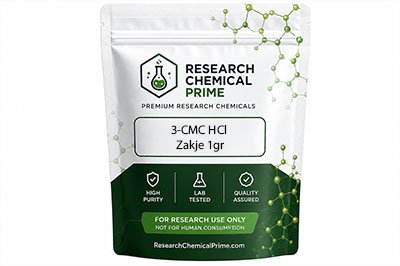
3-CMC HCl — 1 Gram
3-CMC HCl, or 3-Chloromethcathinone Hydrochloride, is a substituted cathinone-related compound of interest in analytical chemistry and comparative research.
Its molecular structure makes it relevant to studies examining substituted cathinone chemistry, structure–activity relationships, analytical detection, and molecular interactions associated with monoamine transporter systems.
The supplied product specification describes a 1 gram quantity of 3-CMC HCl. Claims concerning purity, analytical testing, packaging, or storage should be verified using appropriate batch-specific documentation.
Product Overview
- Product name: RC+ 3-CMC HCl
- Chemical name: 3-Chloromethcathinone Hydrochloride
- Abbreviation: 3-CMC HCl
- Chemical class: Cathinone-related research compound
- Salt form: Hydrochloride
- Quantity: 1 gram
- Intended application: Scientific and analytical research
- Human use: Not intended
- Animal use: Not intended unless specifically authorized under an appropriate research protocol
Technical Specifications
| Parameter | Information |
|---|---|
| Product name | RC+ 3-CMC HCl |
| Chemical name | 3-Chloromethcathinone Hydrochloride |
| Common abbreviation | 3-CMC HCl |
| Chemical class | Substituted cathinone-related compound |
| Salt form | Hydrochloride |
| Quantity | 1 gram |
| Purity | >97% according to supplied specification; verify independently |
| Molecular formula | Confirm against batch-specific documentation |
| Molecular weight | Confirm against batch-specific documentation |
| CAS number | Confirm against authoritative chemical documentation |
| Physical form | As specified for the individual batch |
Research Applications
3-CMC HCl may be relevant to controlled laboratory investigations involving:
- Analytical identification and characterization
- Chromatographic method development
- LC-MS and GC-MS analysis
- Comparative research on substituted cathinones
- Structure–activity relationship (SAR) studies
- Molecular pharmacology research
- Investigation of monoamine transporter interactions in appropriate experimental models
- Comparative chemical profiling
- Metabolite and degradation-product investigations
- Stability and analytical-method validation
Research involving biological systems should only be conducted under appropriate institutional, ethical, and regulatory controls.
Analytical Characterization & Quality Control
The supplied information specifies >97% purity and references HPLC and GC/MS quality control.
These should be considered supplier-provided specifications unless supported by current, batch-specific analytical documentation.
For analytical verification, laboratories may use appropriate techniques such as:
- HPLC
- LC-MS
- GC-MS
- NMR spectroscopy
- Validated quantitative analytical methods
Analytical documentation should identify the batch, analytical method, testing conditions, and reported results.
Packaging & Storage
The source information describes vacuum-sealed packaging intended to reduce exposure to environmental conditions.
The actual suitability of a packaging method for long-term chemical stability should be supported by appropriate stability data.
Storage should follow the applicable SDS, product specification, and institutional chemical-storage procedures. Protect the material from conditions that may contribute to degradation, contamination, or loss of analytical integrity.
The supplied recommendation for refrigerated storage should not be treated as a universal requirement without supporting product-specific stability documentation.
Laboratory Handling
3-CMC HCl should be handled only by appropriately trained laboratory personnel.
Depending on the documented hazard classification and laboratory risk assessment, appropriate controls may include:
- Laboratory coat
- Chemical-resistant gloves
- Safety glasses or appropriate eye protection
- Suitable ventilation or containment
- Avoidance of unnecessary dust or aerosol generation
- Clearly labelled containers
- Appropriate chemical hygiene procedures
- Suitable chemical-waste management
A fume hood should be used where required by the material’s documented hazards and laboratory risk assessment.
Safety Information
3-CMC HCl is a research chemical with potentially incomplete toxicological characterization. It should not be assumed to be safe for human or animal exposure based on structural similarity to other compounds.
The material is not intended for:
- Human consumption
- Self-experimentation
- Recreational use
- Performance enhancement
- Unapproved therapeutic applications
Researchers should consult the current SDS and conduct an appropriate laboratory-specific risk assessment before handling the material.
Environmental Handling
Do not discharge 3-CMC HCl or contaminated laboratory materials into drains, soil, or natural waterways.
Chemical waste should be collected and disposed of through an appropriate authorized laboratory-waste process in accordance with applicable regulations.
Regulatory & Compliance Information
The legal status of 3-CMC and related cathinone compounds varies by jurisdiction and may change over time.
The source information describes 3-CMC as restricted or prohibited in multiple jurisdictions. Such claims should be checked against current official legislation for the specific country or region rather than treated as universally applicable.
Researchers and institutions are responsible for verifying all requirements governing possession, analysis, storage, transport, and research activities.
Documentation
Where available, batch documentation may include:
- Certificate of Analysis (CoA)
- Safety Data Sheet (SDS)
- Batch identification
- HPLC results
- GC-MS or LC-MS data
- NMR characterization
- Product specification sheet
- Storage information
Batch-specific documentation should be used when confirming chemical identity, purity, and analytical quality.
Frequently Asked Questions
What is 3-CMC HCl?
3-CMC HCl is the hydrochloride salt of 3-Chloromethcathinone, a substituted cathinone-related research compound.
What quantity is supplied?
The supplied product specification describes a 1 gram quantity.
What type of research is relevant to 3-CMC HCl?
Potential research areas include analytical chemistry, substituted cathinone characterization, molecular pharmacology, analytical detection, and structure–activity relationship research.
Is 3-CMC HCl intended for human consumption?
No. It is intended strictly for scientific and analytical research.
Is the stated >97% purity independently verified?
The >97% figure is a supplied specification. It should be confirmed using current batch-specific analytical documentation where required.
What analytical techniques can be used?
Depending on the research objective, laboratories may use HPLC, LC-MS, GC-MS, NMR, and other validated analytical techniques.
Is 3-CMC HCl legal everywhere?
No. Regulatory treatment varies by jurisdiction. Current official legislation should always be consulted before conducting research.
Research-Only Disclaimer
This material is described solely for legitimate scientific and analytical research. It is not intended for human or animal consumption, administration, diagnosis, treatment, supplementation, recreation, or performance enhancement. Researchers are responsible for appropriate laboratory safety, risk assessment, documentation, waste management, and compliance with all applicable laws and institutional requirements.

Reviews
There are no reviews yet.