
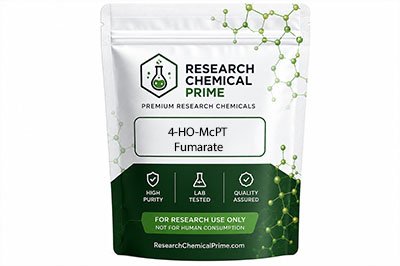
4-HO-McPT Fumarate | Tryptamine Analytical Reference Standard
4-HO-McPT Fumarate (4-Hydroxy-N-methyl-N-cyclopropyltryptamine fumarate) is a specialized semi-synthetic substituted tryptamine derivative. Characterized by its distinct 4-hydroxy group alongside an N-methyl and N-cyclopropyl substitution pattern, it serves as a critical reference standard for advanced scientific investigation into serotonergic signaling pathways, unique receptor kinetics, and structure-activity relationships (SARs) within the broader tryptamine class.
Supplied as a highly stable fumarate salt, this format is specifically engineered for laboratories requiring exceptional chemical stability, precise stoichiometry, and reliable dissolution in analytical solvents. It eliminates the degradation risks and handling difficulties associated with freebase tryptamines, ensuring reproducible results for quantitative in vitro workflows.
Key Features & Quality Assurance
- Exceptional Analytical Purity (≥98%): Rigorously verified via HPLC and NMR to ensure reliable baseline data and minimal synthetic impurities.
- Optimized Stability: The fumarate salt form significantly enhances crystallinity and resistance to oxidative degradation, facilitating precise in vitro stock solution preparation and extended archival storage.
- Distinct Binding Profile: The compact and rigid cyclopropyl group offers a unique structural-affinity profile compared to classical N,N-dialkyltryptamines, making it highly valuable for comparative receptor selectivity studies.
- Comprehensive Analytical Certification: Every batch is accompanied by detailed certificates confirming purity, identity, and Karl Fischer water content (≤0.2%).
Primary Research Applications
- Receptor Binding Assays: In vitro evaluation of ligand affinity and modulatory effects at specific serotonergic receptor subtypes, particularly 5-HT2A and 5-HT1A.
- Comparative Structure-Activity Relationship (SAR) Studies: Analytical comparison with 4-HO-DMT, 4-HO-MiPT, and 4-HO-MPT to map the pharmacological impact of the N-cyclopropyl substitution on receptor binding profiles.
- In Vitro Metabolic Profiling: Investigation of enzymatic degradation pathways and metabolic stability in controlled microsomal or cellular models.
- Forensic & Analytical Reference: Utilized as a certified calibration standard for method validation and detection in toxicological laboratories (LC-MS, HPLC, NMR).
Technical Specifications
| Chemical Name | 4-Hydroxy-N-methyl-N-cyclopropyltryptamine fumarate |
| Molecular Formula | C₁₄H₁₈N₂O · C₄H₄O₄ |
| Molecular Mass | ~346.38 g/mol |
| Physical Form | White to off-white crystalline powder |
| Purity | ≥98% (HPLC Verified) |
| Melting Point | 122–124 °C |
| Solubility | Freely soluble in ethanol, methanol, and DMSO; limited in water |
Handling & Stability Considerations
- Light & Moisture Sensitivity: Hydroxytryptamine salts are prone to oxidative degradation. Store strictly in airtight, light-proof containers with desiccant.
- Controlled Environment: Handle exclusively in a professional, ventilated laboratory setting (preferably under a certified fume hood) to prevent aerosol exposure.
- Mandatory PPE: Always utilize appropriate Personal Protective Equipment, including a laboratory coat, chemical-resistant nitrile gloves, and safety glasses.
- In Vitro Concentration Guidelines: For cellular binding assays, typical working concentrations require careful optimization in the micromolar (µM) range (e.g., 1–50 µM), depending on the specific cell line and assay protocol.
- ⚠️ Critical Warning: This product is an analytical reference standard only. It is NOT approved, tested, or intended for human or animal consumption, therapeutic use, or household application.
Frequently Asked Questions (FAQ)
How does this molecule differ from other 4-HO-tryptamines?
4-HO-McPT features an N-methyl-N-cyclopropyl substitution pattern, whereas compounds like 4-HO-DMT feature an N,N-dimethyl pattern. In in vitro receptor binding assays, the rigid cyclopropyl group introduces distinct steric and electronic properties, altering the binding kinetics and lipophilicity at 5-HT receptor subtypes, making it highly valuable for comparative SAR studies.
What is the recommended concentration for experiments?
For in vitro analyses, it is recommended to optimize working concentrations in the micromolar (µM) range, depending on the specific cell line, assay protocol, and desired signal-to-noise ratio. Always consult the batch-specific CoA for precise stoichiometric calculations.
How should this compound be stored for maximum stability?
Store in an airtight, light-proof container in a cool, dry environment (maximum 20°C, ideally 2–8°C or -20°C for long-term archival). Proper storage is critical to prevent oxidative degradation of the compound.
What is the regulatory status of this compound?
Regulatory status varies significantly by jurisdiction. Substituted hydroxytryptamines are frequently subject to strict controlled substance legislation or analogue acts. It is permitted solely for authorized scientific research. The purchaser is solely responsible for verifying compliance and possessing any required institutional permits prior to ordering.

Reviews
There are no reviews yet.